La Rioja
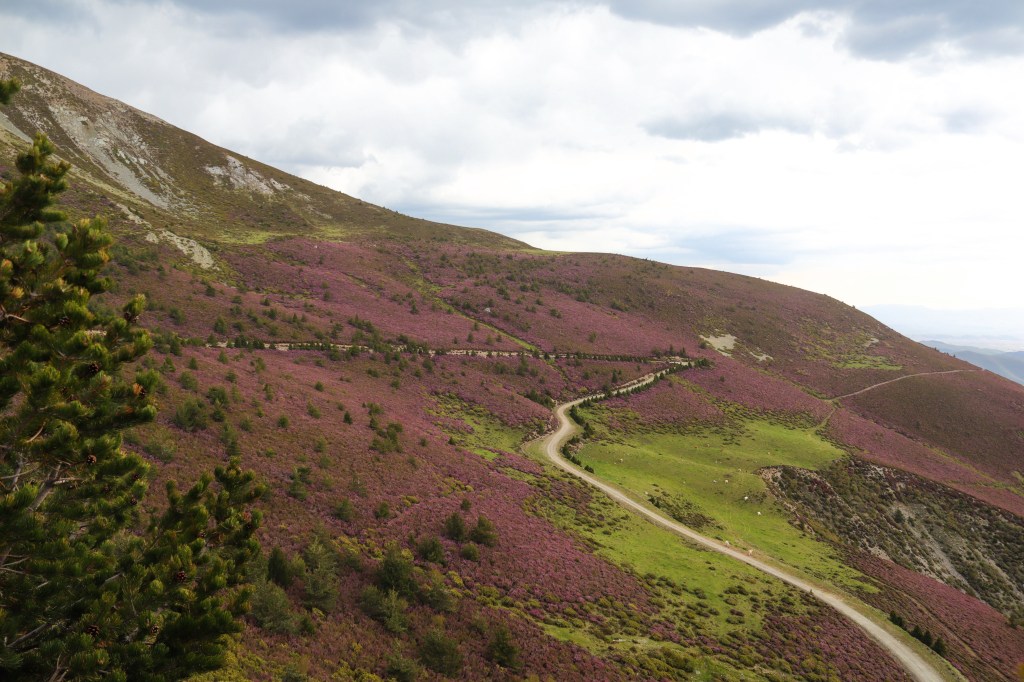
From slender mountains at the south that exceed 2000 meters in height, belongs to a part of the Iberian system. That of the seven valleys, since there are seven main rivers that rise in these mountains to flow into the Ebro, the natural border to the north with the Basque Country and Navarre, mostly occupied by vineyards and cultivated fields. Flanked to the west and south by Castilla León, with whom it shares mountains.
With Logroño as the capital, and towns such as Haro, Arnedo, Calahorra or Ezcaray as the headwaters of the region, it is a land known internationally for its famous wines. Historically occupied by tribes, this land has been a border and crossroads between different peoples and cultures. Land of passage for those who travel the Camino de Santiago. One of the most important paleontological territories worldwide in terms of its dinosaurs footprints sites, and the cradle of the Spanish language in the monasteries of San Millán de la Cogolla classified as a World Heritage Site by Unesco.
Being the autonomous community with the smallest population in Spain, most of its inhabitants live in the capital and in areas close to the banks of the Ebro, with the Sierras de la Demanda, Cebollera and Cameros being the most unpopulated areas. With friendly and hard-working people, a pleasant climate most of the year and fertile soil, La Rioja is undoubtedly a little jewel to explore by bicycle.
The Concept. How Ibérica Norte Borns.
You have to go back a few years to get to the origin of the idea of this route. It was thanks to a good friend, with whom, in addition to cycling, I shared work, who brought me closer and gave me a bigger vision of the bicycle as a means of travel, bikepacking, cycling touring or whatever we want to call it. I have always been a person predisposed to discover new places, to travel and to know other people and other cultures. As far as cycling is concerned, shortly after starting to explore La Rioja and other parts of the peninsula by bicycle, and after many outings with friends and alone around this land, the idea of connecting in a single tour the entire autonomous community. After many drafts, many outings and many hours of planning, I decided to cover a little more territory and not only close myself to the autonomous community in which I live.
The route is made from the town where I live, in the middle of the Oja valley, a river that they say, gives its name to the community, but it can be done from any other point, such as the capital, Logroño, since the route is circular. The technical difficulty of the route is not very high in terms of the terrain on which you are going to ride. Although the stages that run along the banks of the Ebro are easier, the unevenness and large isolated areas throughout the mountainous area are an important factor to take into account.

At first, the idea seems simple, but the reality is that there are countless ways to do it. Ibérica Norte was born with the idea of touring La Rioja, also entering different areas of Soria, Navarre and Álava, beginning and ending in Ezcaray, completely crossing the Rioja mountains that make up this northern part of the Iberian System, through the mountains de la Demanda, Cameros, Cebollera and Alcarama, closing the circle along the banks of the Ebro River that crosses this community for approximately 120 kilometers, between a sea of vineyards and cultivated fields sheltered by the Sierra de Cantabria. The objective is to make this part of the Spanish geography known through the bicycle, highlighting some of the most significant natural and cultural points of this land.
Normally, I always try to leave the asphalt aside. Most of the time you will ride on forest tracks, but you will also find paved sections, mostly on secondary or mountain roads. The bike you choose to ride is up to you. With a mountain bike, there will be areas where you will perform better, and the same happens in other parts of the course with a gravel or travel bike. However, whatever bike you choose, keep in mind that it is a long route and in many areas, demanding. There are also short sections in which to navigate with a loaded bicycle, it will be difficult for you and you may have to put your foot on the ground and push, but you know… «-never go for a hike without my bike-» The route is divided into stages but only as a guide, that is, what works for one person may seem too much for another and for another it may fall short, so plan your route before leaving and be consistent with your fitness level and state. It is not an initiation route, nor is it a walk through the countryside.
I invite you to enjoy the route in a relaxed way, to enjoy the surroundings and the landscape. Let yourself be soaked in the culture of the towns you pass through, their people and their customs. Do it alone, or in company. Or meet those friends you haven’t seen for a while and share it with them. But whatever you do, remember that the only objective is to enjoy, connect with the environment and meet new places and people through the bicycle.
The Track.
550 Kilometers are the main base of Ibérica Norte. For now, a shortcut to shorten the route for those who have less time or want to do it in different loops.
In the near future, my idea is to continue adding routes or loops through the northern part of the Iberian system and its surroundings as I explore and discover more ground.
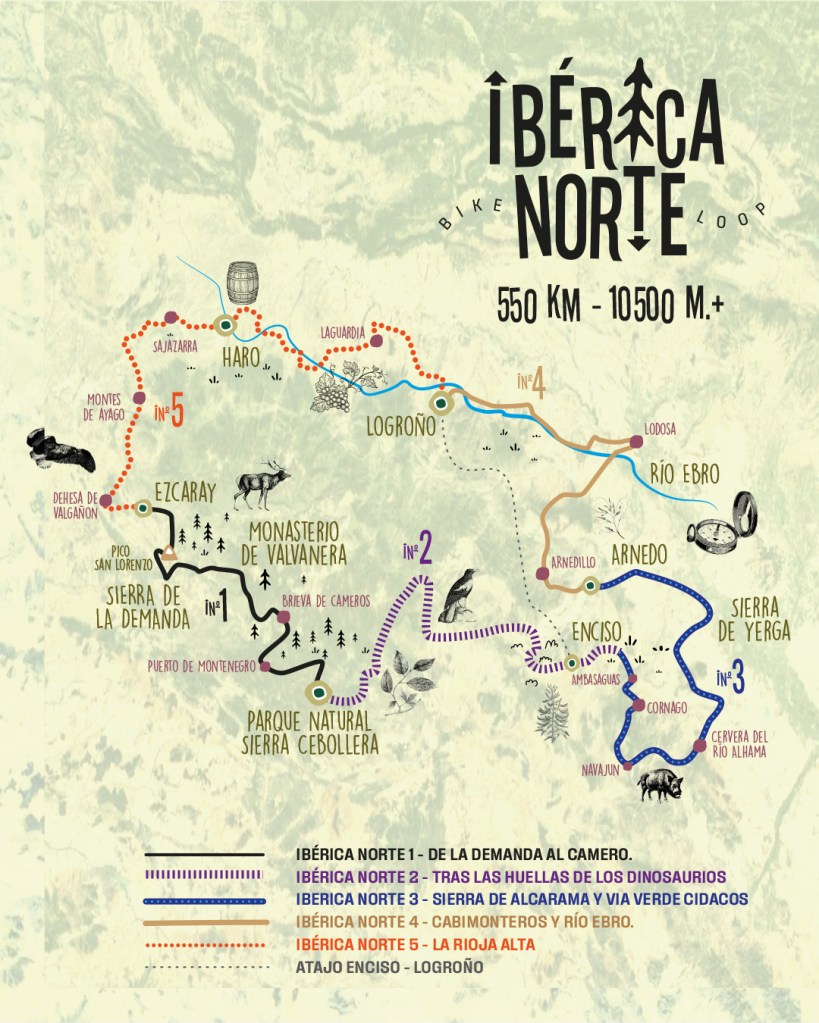
Below you have access to the google maps where you can find the different stages in which I have divided the route. Remember, that it is only indicative. You choose where to start and where to end the tour.
De la Demanda al Camero. 96KM-2630m+
Tras las huellas de los dinosaurios. 114Km-2685M+
Sierra de Alcarama y Vía verde del Cidacos. 106KM-2090M+
Cabimonteros y Río Ebro. 96KM-1000M+
La Rioja Alta. 134KM-2150M+

 La Demanda Cycling.