FOOD.
Try to always carry food with you for more than one day. It is true that you will go through different towns and that in some of them, it will be easy for you to have access to food through bars, shops, and maybe even a supermarket in bigger towns. However, you never know what can happen in areas where you are more isolated, if an emergency situation arises. There are areas where, despite the fact that you are going to cross towns, there is only one small store, which opens at a certain time, there may be only one bar, which may be closed, or there may be nothing.
From my point of view, it is better to carry some extra food in your saddlebags or in your bikepacking bags. Plan your route and your stops. Take the opportunity to replace food when you have the opportunity and think about what you will need later, depending on the number of stages and kilometers that you have left to cover.
WATER.
At first, water should not be a problem during the route. As with food, it is advisable to plan well and take the opportunity to refill the bottles when possible. Normally with a liter and a half you should have no problem going from one water point, be it a fountain or spring, to the next. However, my recommendation is that you take with you an extra bottle or container for water. During the night it is possible that you sleep in a place that does not have a source, and you will surely use a good amount to rehydrate after a long stage, cook, spend the night and have breakfast. A small hydration bag or a collapsible bottle can be a good ally. They weigh little and when folded they hardly take up space.
You can also consider the option of taking a filter with you to be able to filter water at some point. As I have said, it is normal that you do not have a problem finding water, but it is true that in the central months of the year, some sources may be dry and some areas located at higher altitudes may not have sources. It’s sad to even write it, but even in the end of winter I have found some dry source.
Central months of the year, depending on the areas of the route, can be really hot. The easternmost area of La Rioja, known as Rioja Baja, is a much drier area where the heat takes its toll. Don’t forget to hydrate frequently while traversing these areas.
SLEEP.
You will find general information about where to sleep in the downloadable guide. (downloads tab) Here are a couple of tips for you to take into account when planning your nights.
-Camping as such is prohibited. It is allowed to bivouac from one hour before sunset to one hour after sunrise. The bivouac is also regulated in the PRUG (regulatory plan for use and management in Spanish) and in areas such as La Sierra de la Demanda and Cameros, it is necessary to request the pertinent permits from the general directorate of the natural environment.
-Within the area of the Cebollera natural park, camping is prohibited outside the places authorized for it, and as in La Demanda and Cameros, authorization is required by means of a permit from the natural environment management.
SAFETY.
Make sure you bring what you need with you. The most basic things are sometimes what we forget most easily. Include a first-aid kit in your luggage with what is necessary to try to reach or continue to a point where you can receive help if necessary. It includes a thermal blanket (there are those in sack format too. They are really useful and are sold by a well-known European blue company), something that can help you with stomach problems, something to disinfect wounds with, and even adhesive stitches. You will not have to use it, but it does not hurt to have it on hand in your saddlebags in case you have to use it yourself or in case you have to give help to another person. Remember that in the mountains you can meet different users.
Remember that at a certain time of the year when the days get shorter, you probably need an external light to get around by bike. In addition, my recommendation is that you use a red light so that vehicles can distinguish you more easily on secondary roads that you can find or at night. A flashlight or a head light (or both) will be very useful. Remember to respect the road traffic regulations and also the traffic regulations between cyclists and other groups that you may find in the mountains. (hikers, horse riders, mushroom pickers, hunters…)
It depends on you if you choose, or not, to do the route with a contracted sports insurance. If so, make sure that the insurance coverage meets the requirements of the activity you are going to do. Let your friends or family know what activity you are going to do, estimated time, stops, etc. If you are going to do the route alone, so that in the event of an accident they can have a record of the area where you might need help. your last location etc…
– “Remember that the only person responsible on this route is you. You are responsible for your actions, your decisions and your own safety. Do an activity according to your state of physical condition, preparation and previous experience. Remember that it is not a simple bike ride through the countryside. Travel identified, be kind and respectful of the people and the environment in which you are going to move”-
THE WEATHER.
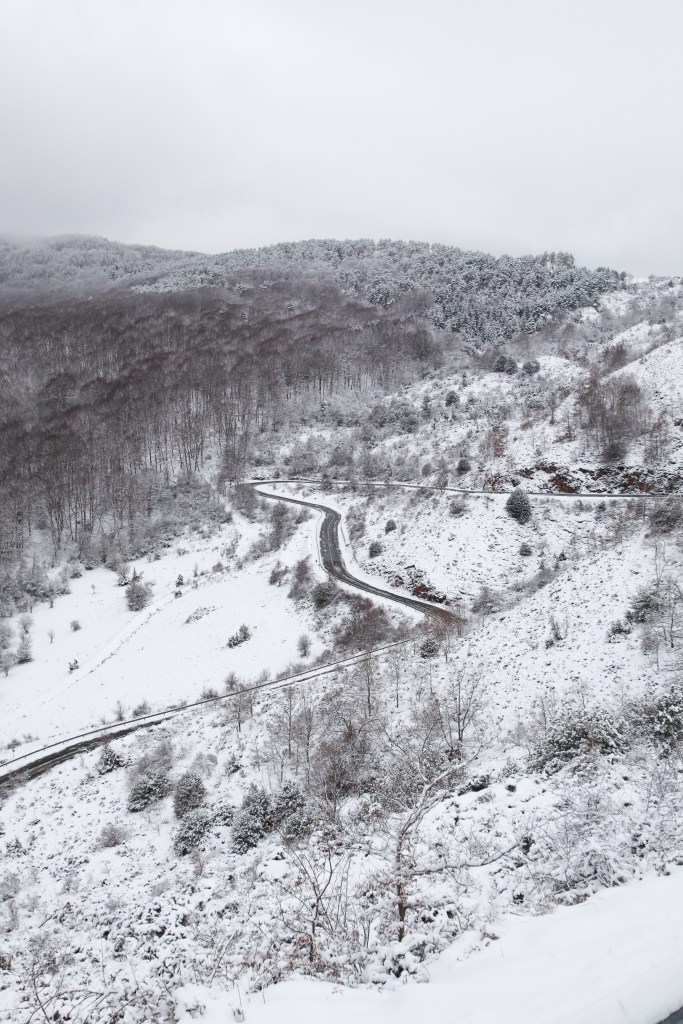
You are going to go through a really large mountain area where during the winter temperatures can drop several degrees below zero. In winter, it is most likely that you will not be able to do the original route, since a large part of it is possibly covered in snow (there are many sections above 1500m in height) and it is not strange that during spring and summer fall, the weather changes drastically from a hot and sunny day to a cold one, with rain or snow.
My recommendation is, that at any time of the year you include in your luggage a warm garment (down or similar) and a good jacket for the water. Also, on the other hand, summer days in areas along the banks of the Ebro and Rioja Baja can be really hot, exceeding 30 degrees Celsius. It is also common during winter and spring to find dense fog on this same bank of the Ebro that does not disappear for days, and that brings with it humidity and cold.
Take all this into account, and do not forget it when planning your activity, because I would say that although the unevenness is in some stages the most difficult part, adverse weather of this type could really hinder the course of the route and make it a really tough experience. Good planning is necessary and one of the keys to success.
 La Demanda Cycling.